 |
 |
 |
 |
 |
 |
 |
|
||
 |
 |
 |
 |
 |
Engines |
|
|
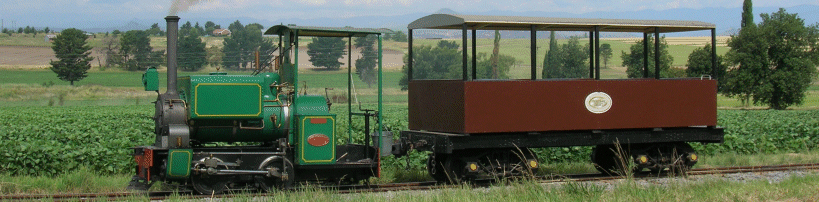
| Sundays River Irrigation Board "Little Bess" 0-4-0ST Kerr Stuart 4031/1919 |
||||
 |
||||
One of the smallest locos in South Africa, next to Sandstone's Decauville, is the "Wren" class built be Kerr Stuart as number 4031. The origins of this type can be traced back to an 0-4-0ST, number 850, supplied to the Southern Gas Company in 1903. Two further units were supplied to Spain, known as the "Buya" class. The locomotive type was developed over the years and 163 were produced before Kerr Stuart closed in 1930. Hunslet acquired the drawings and production rights and produced a further four. The true Wren type had modifications to the boiler and frames for 2ft or 60cm gauge, in fact the majority (132 plus the Hunslet 4) were built to this gauge. There were two basic types: the "old" type up to number 2423 which had Stephenson Link Motion between the frames and the "new" type from number 2458 with outside Hackworth valve gear. Nevertheless six "old" type were built after number 2458, probably as repeat orders for customers who wanted identical locomotives to their current ones. The "new" type also incorporated a higher pitched boiler, inclined cylinders and various other detail differences and appeared in 1915. Wrens were a very popular loco type and were delivered all over the world to such countries as Brazil, Borneo, Malaya, Aden, New Zealand and even the Falkland Islands. The last example, built in 1941, went to the National Smelting Company at Avonmouth near Bristol but was sadly scrapped in 1955. Few survive to this day but "Little Bess" is one of them. After service with the Sundays River Irrigation Board, "Little Bess" was abandoned until being discovered in a wooded area in 1974 by a group of Eastern Cape enthusiasts. The Eastern Cape branch of the RSSA acquired the locomotive and it was restored to working order. "Little Bess" then found a home at Willow Dam near Uitenhage where she hauled two small wooden coaches on a 300m oval track. This lasted until the late 90s when the service stopped and the loco was staged. Vandalism was soon rife and parts were stolen. The engine graffitied and armatures, turret, locomotive plate, injectors, bearings, lubricator, copper pipes are stolen, The boiler and the smoke box are strongly damaged by fire (Steam boilers are not designed to be heated up without water in the boiler). Just one day after "Littlebess" was safe sored at our workshop, we went busy with cleaning the loco shed at the Willowdam, an other truck with crane arrived and went load the engine. On our request: what they like to do her, we got the answer that they would are here to collect the Littlebess to ship it to UK. The 2 Foot Preservation Trust and well known Port Elizabeth enthusiast, Roy Mitchell, began restoration of "Little Bess" and stripped the loco to its component parts. Following Roy's tragic death in 2003, the project ground to a halt. In the meantime Sandstone had moved our two small coaches to Hoekfontein for safe keeping and to use them at the Sandstone Heritage Fair in 2003. Following negotiations with the Sandstone, it was agreed to move "Little Bess" to Sandstone to complete the restoration. Initially work began in Pretoria but the loco was transferred to Bloemfontein and completed by Lukas Nel and his team in time for her first appearance at the Sandstone Winter Steam event in June 2005. "Little Bess" is painted green. |
||||
|
|
||||
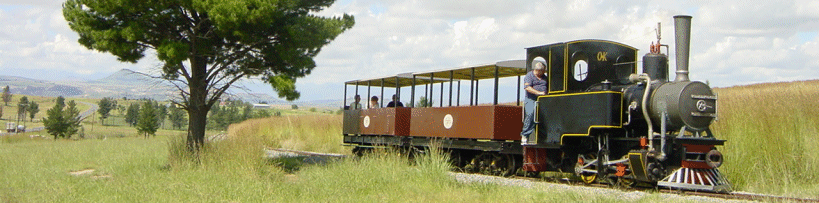
| Ex West Rand Consolidated Mines 0-4-0WT Orenstein & Koppel 4102/1910 |
||||
 |
||||
Built in Berlin, number 4102 is only one of three narrow gauge examples owned by local companies which exist from this prolific German manufacturer. Delivered in 1910 it is one of the 50hp type. Originally used at West Rand Consolidated Mines it was sold to Vogelspruit Gold Mining Areas Ltd in 1936 and retired when the mine regauged to 3'6". In 1952 it appears to have been rebuilt for use on the children's railway at the mine. On the mine closure in 1968 it was transferred to West Driefontein before being donated to the Midmar 2ft project in 1990. Some restoration work was done here but was unfinished when the Midmar railway was closed in 1998. Together with a number of other items the O&K was put up for auction and sold to the 2ft Preservation Trust and moved to Port Elizabeth. The new owners were keen for the loco to be restored and it was transferred on loan to Sandstone in 2002.The restoration began early in 2003 and was subcontracted to Steven's Mechanical in Howick. The restoration was extensive with most of the tanks being replaced, a new rear buffer beam was fabricated together with piston and valve rods. New axle bearings were machined and many brass fittings remanufactured or replaced. The loco was finished in black with yellow lining and returned to Sandstone in May 2003. |
||||
|
||||


